

Imagine a customer asks their phone, “What is the best local cafe in Kuala Lumpur?” or “Which software company in Malaysia has good support?” If your brand is missing from the answer, you lost that customer before you knew they were looking.
The way people search is changing. They want direct answers, and they increasingly ask AI to get them. Gartner expects search engine volume to drop 25% by 2026 as people shift to AI chatbots and assistants. This is happening now, not later.
We have run Adam SEO for more than 10 years, helping Malaysian businesses stay ahead of shifts like this one. This guide explains why AI visibility matters to your revenue, and shows the exact process we use to track and improve it.
Why AI visibility affects your bottom line
This is about being chosen, not just being found. The move to AI changes how customers find you and decide whether to trust you.
- Your customers already decide here. A large and growing share of consumers now use AI for product ideas, and many use it for local recommendations, from restaurants to professional services.
- AI reads like a trusted referral. People tend to treat an AI assistant’s answer as unbiased expert advice, which is exactly what advertising spends millions trying to manufacture.
- Old metrics hide the gap. A top Google ranking does not guarantee a mention in AI answers, so your old SEO report can leave a blind spot.
For any business in Malaysia’s competitive market, ignoring AI is like letting a competitor answer your phone.
The hidden risk when AI cannot see your brand
An AI model wants to give a complete answer. If your official information is unclear or hard to find, the model fills the gap from other sources. That creates real problems:
- Bad news spreads. A single negative review or an old critical article can be pulled into an AI summary and unfairly define your brand.
- Wrong facts get repeated. The model might state old pricing, a discontinued product, or an incorrect address as current fact.
- Competitors take the spotlight. Every time a buyer asks a question and a competitor gets named instead of you, their authority grows and yours gets harder to rebuild.
These are direct business risks, and they need an active plan.
Our process for AI visibility
We replace guesswork with a data-driven process that we run end to end for clients.
Phase 1: the AI brand audit
We start with a hands-on audit. We ask AI models dozens of questions, from broad industry topics to specific competitor comparisons, to get a clear read on the sentiment and accuracy around your brand. This is the human insight that raw data misses.
Phase 2: ongoing visibility monitoring
A one-time check is not enough when things move this fast. For steady data we use a dedicated monitoring tool. Big enterprise platforms exist, but they are usually too expensive for local businesses. Our brand visibility monitoring platform of choice is BrandPeek. It gives us the precision we need to turn AI noise into clear, useful insight.
How to set up brand monitoring in ChatGPT with BrandPeek
Here is the process we run for clients, step by step.
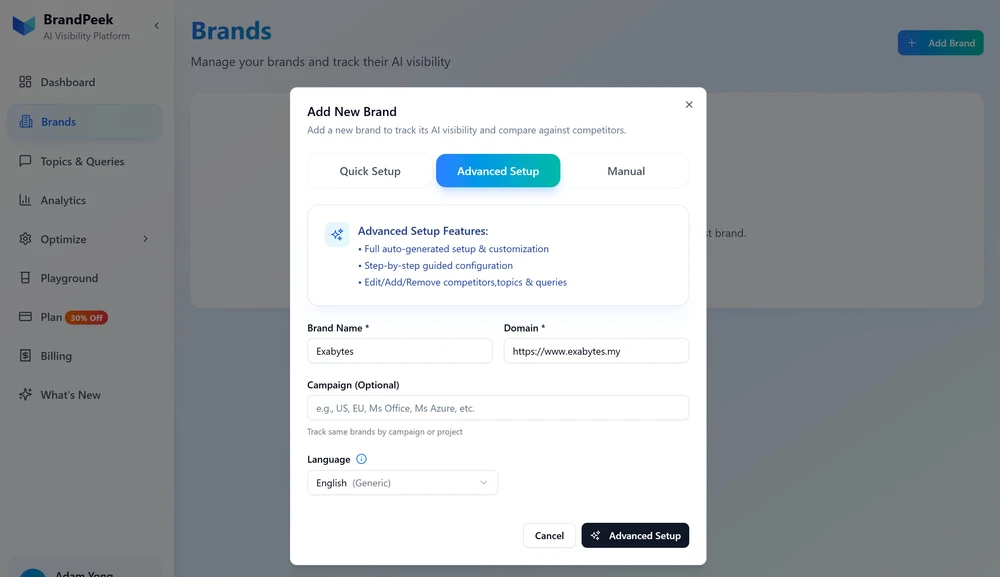
1. Strategic campaign setup. We open the Advanced Setup Wizard and enter your core brand information: brand name, domain, and optional campaign tags like “Q4 Product Launch” so each data set ties back to a business goal.
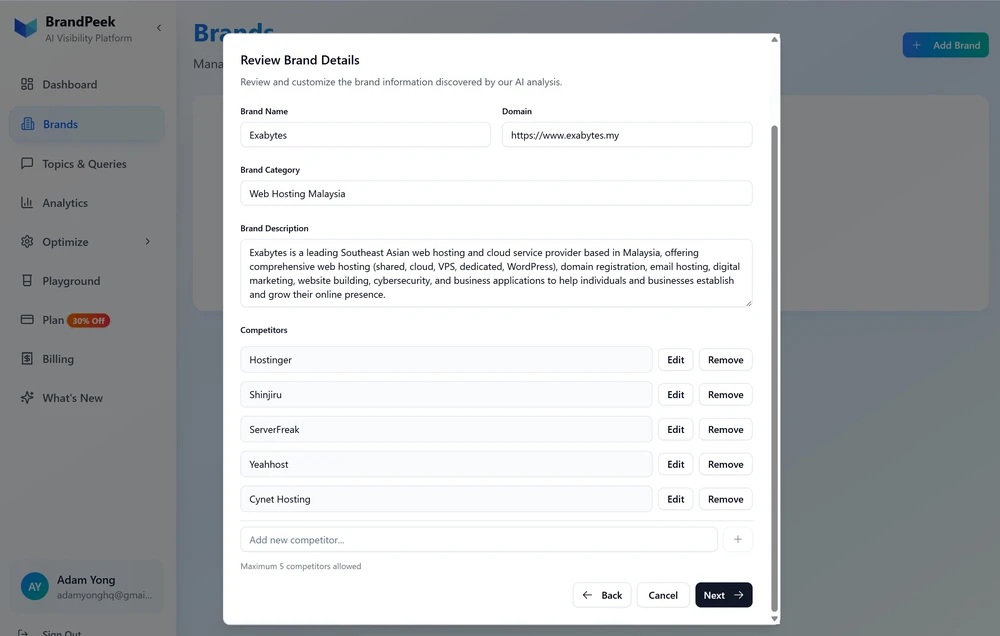
2. AI analysis and competitor benchmarking. The platform analyses your website and builds a baseline. In under a minute it identifies your industry, describes your business, and suggests your main competitors. We review that list and lock in the 5 most relevant rivals, because visibility only means something next to your competition.
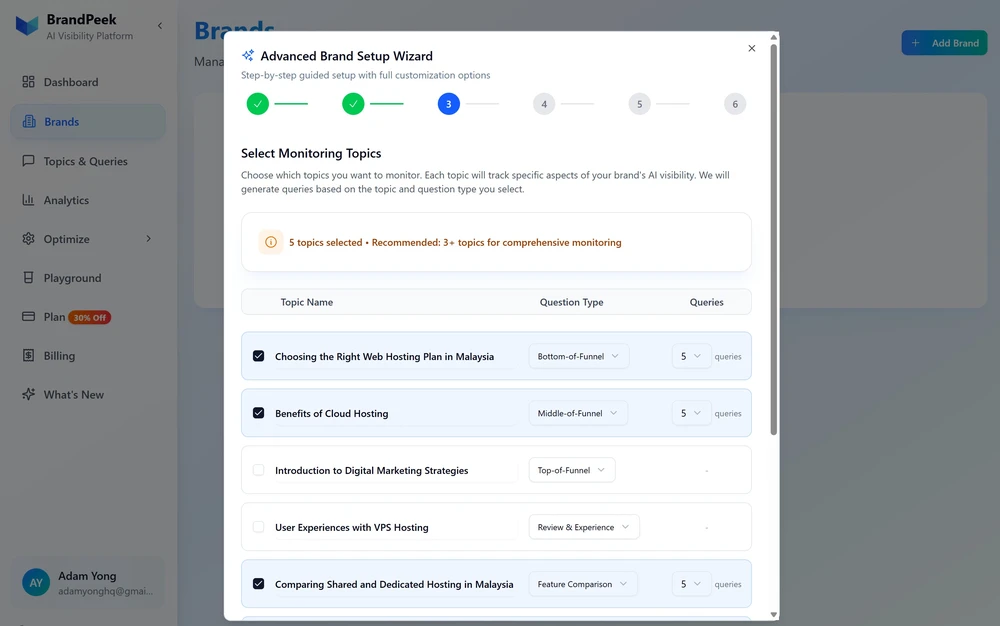
3. Defining the monitoring topics. We choose what to track. The tool suggests topics and we select the ones tied to your goals, customising the angle for each. Common topics include:
- Brand reputation: how buyers perceive you.
- Purchase intent: whether you appear when customers are ready to buy.
- Problem and solution: whether you show up as the fix for common industry problems.
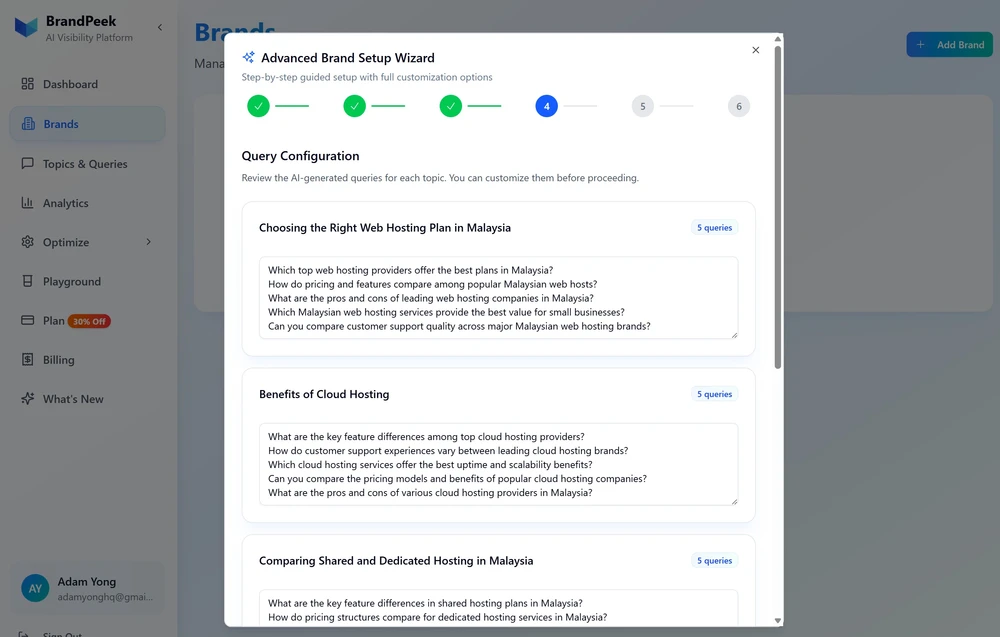
4. Crafting high-quality queries. The platform generates the questions to ask the AI models. This is where SEO experience matters. A generic question gets a generic answer, so we review, edit, and add custom queries that dig for real insight about your brand and competitors. These are the exact questions sent to ChatGPT.
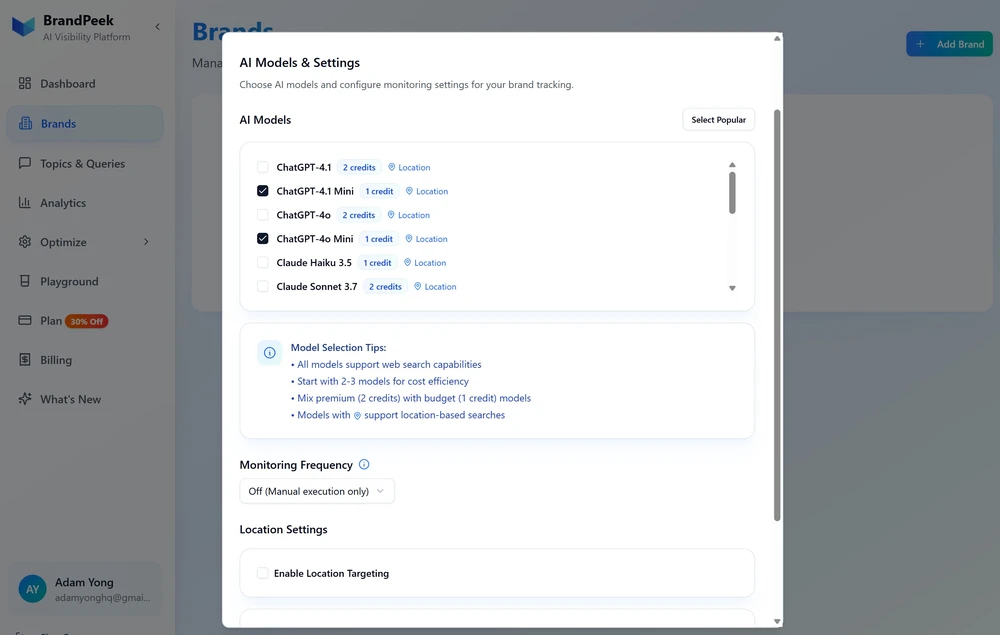
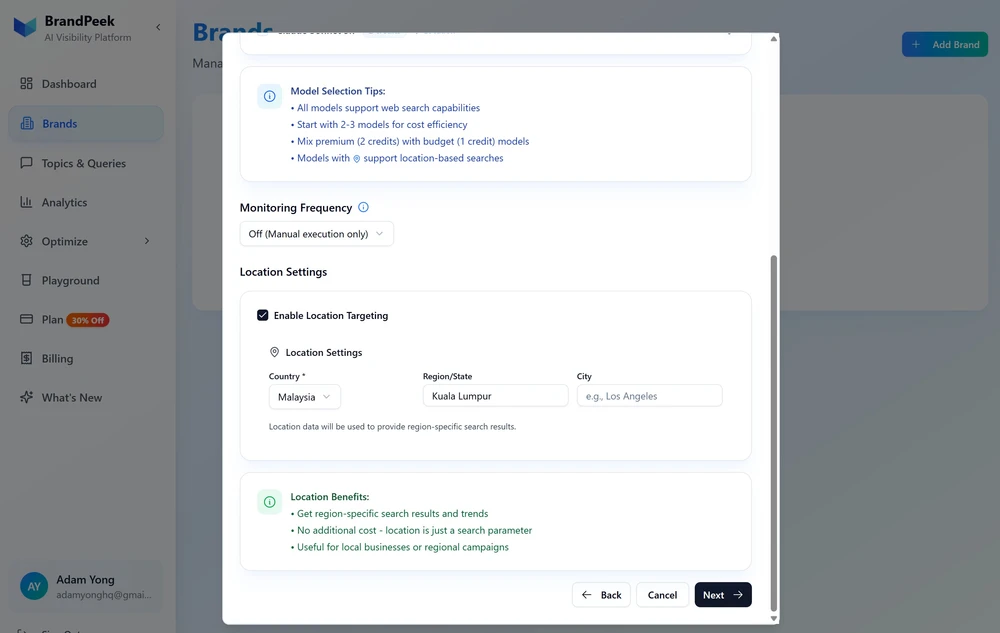
5. Selecting models and local targeting. We pick which AI models to query, focusing on current ones like OpenAI’s GPT-4o. For clients in Malaysia we then enable location targeting, so the results reflect what local customers actually see rather than a generic global answer.
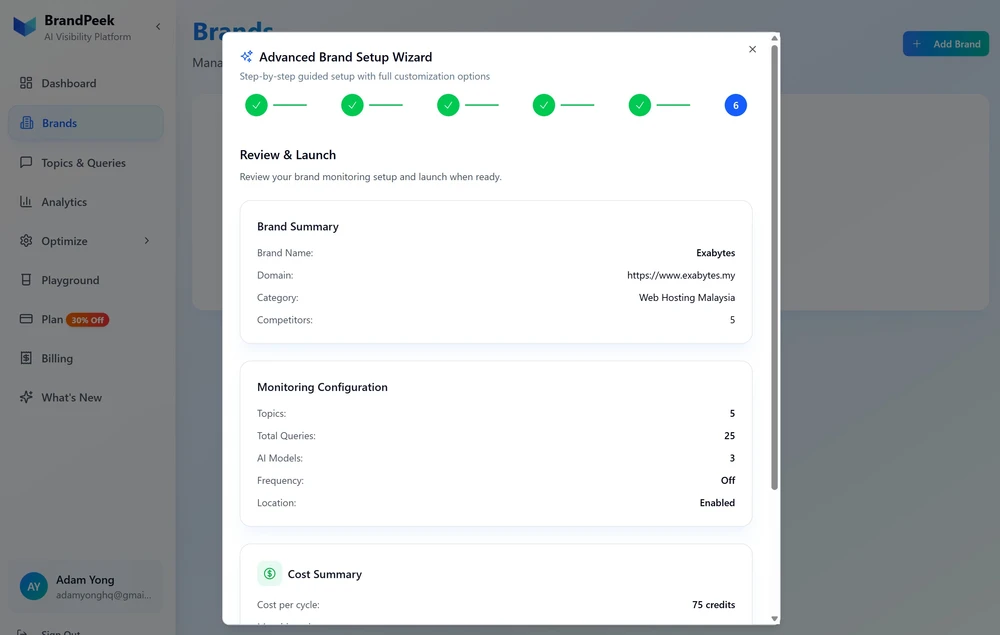
6. Launching and managing the campaign. We review the full setup and launch. The system runs on a daily or weekly schedule, sends the queries, and collects the data. We manage the technical side, including credit usage, so you only deal with results.
From data to action
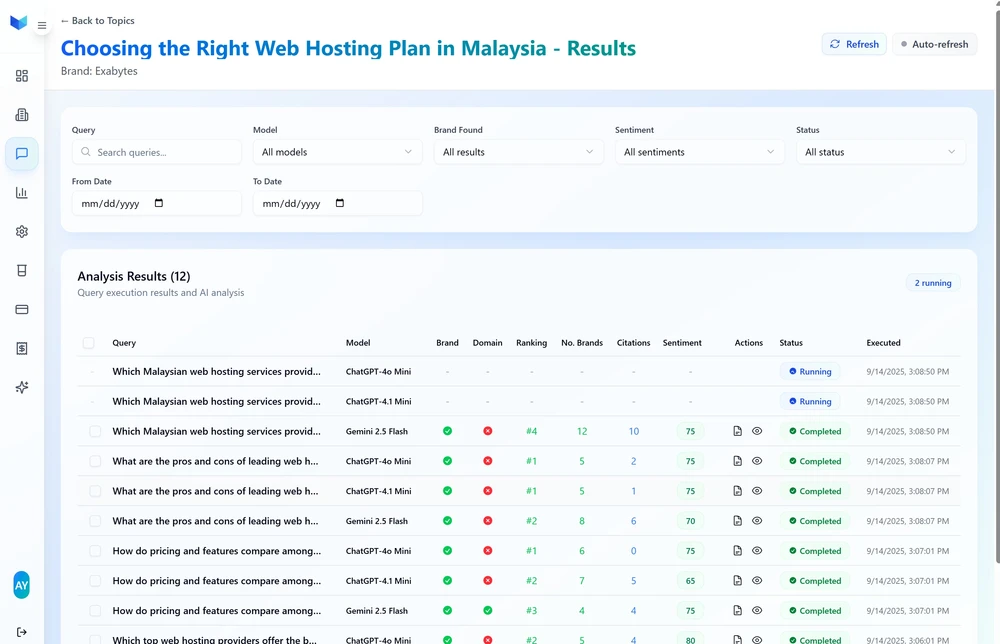
Tracking is half the job. The value comes from acting on the data. We turn the monitoring results into a targeted plan:
- Answer engine optimization: we rewrite your content to answer the questions buyers ask AI, which makes your site a stronger source for the models.
- Technical SEO and schema: we add schema markup so machines read your pages cleanly, which makes your content easier for AI to cite.
- Reputation management: we use the sentiment data to guide your review strategy, because more positive reviews on key platforms send a trust signal to AI.
- Authority features: AI models lean on well-known sources, so we find places for your brand to be featured on trusted industry sites.
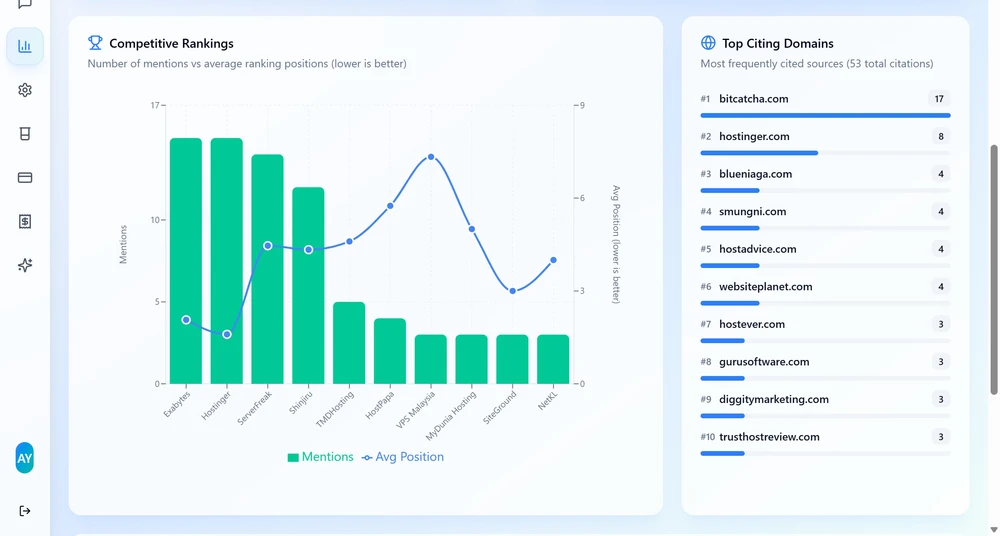
Where your brand stands today
The move to AI search is speeding up. Businesses that manage their visibility now build an advantage that late movers struggle to close. Your reputation in AI is being shaped right now, with or without you.
If you want to see where you stand, you can request an AI visibility audit. We will benchmark your brand against your competitors and map a plan to make you the answer when customers ask. For the underlying playbook, our guide on how to rank in AI Overviews and answer engines covers the workflow in detail.